Russian Academy of Sciences Centre for Egyptological Studies, Moscow (CESRAS) & Russian Institute of Egyptology in Cairo (RIEC) |
UPDATED 26.11.2014. CESRAS Research Fellow Edward R. Loring, Editor
The site is now being completely rebuilt. Whereas the previous version was largely a "picture book", the
version now under construction will be of a more educational nature. As the majority of our worldwide
visitors do not have access to egyptological literature, we are posting full text web editions of "classic"
works from the early days of our science: Maspero, Smith, Daressey, Brugsch etc., the words of people
who were there when Egyptology was in its childhood, with digitally improved images of their original
black & white plates and marginal comments and corrections of outdated and incorrect material. An
improved navigational system of links allows instant comparison of equivalent text passages and images
which apply to more than one source. We suggest that new visitors read the instructions for efficient use
of the system which can be called from the site directory. This project will obviously take much time.
It is "open-end" and will never cease to being augmented with new material from CESRAS' thousands of
original, largely unique, and growing, photograph archive. We place all of our material in the public
domain. You may download and use any parts of it for non-commercial purposes.
As before, the site will consist largely of original photographic material made by CESRAS researchers
during the past 15 years in Russian museums, in republics of the former Soviet Union, and naturally in
Egypt. You may address any questions without hesitation to admin@cesras.org and we will give any
possible answers. All questions are valid and will be answered to the best of our ability as time allows.
The early texts are published as .jpg images of each page, thus allowing you to download only the pages
that you need.
Our re-excavation of the "Royal Cache", Theban Tomb 320, between 1998 and 2006 has caused us to
collect as much material possible on the 21a Theban Dynasty (1070-945 BCE), the family dynasty of
Pianch pAyanx, the dynasty of the High Priests of Amun (HPA) in Thebes. This period forms the central
theme of the site. Scroll down.
The site is now being completely rebuilt. Whereas the previous version was largely a "picture book", the
version now under construction will be of a more educational nature. As the majority of our worldwide
visitors do not have access to egyptological literature, we are posting full text web editions of "classic"
works from the early days of our science: Maspero, Smith, Daressey, Brugsch etc., the words of people
who were there when Egyptology was in its childhood, with digitally improved images of their original
black & white plates and marginal comments and corrections of outdated and incorrect material. An
improved navigational system of links allows instant comparison of equivalent text passages and images
which apply to more than one source. We suggest that new visitors read the instructions for efficient use
of the system which can be called from the site directory. This project will obviously take much time.
It is "open-end" and will never cease to being augmented with new material from CESRAS' thousands of
original, largely unique, and growing, photograph archive. We place all of our material in the public
domain. You may download and use any parts of it for non-commercial purposes.
As before, the site will consist largely of original photographic material made by CESRAS researchers
during the past 15 years in Russian museums, in republics of the former Soviet Union, and naturally in
Egypt. You may address any questions without hesitation to admin@cesras.org and we will give any
possible answers. All questions are valid and will be answered to the best of our ability as time allows.
The early texts are published as .jpg images of each page, thus allowing you to download only the pages
that you need.
Our re-excavation of the "Royal Cache", Theban Tomb 320, between 1998 and 2006 has caused us to
collect as much material possible on the 21a Theban Dynasty (1070-945 BCE), the family dynasty of
Pianch pAyanx, the dynasty of the High Priests of Amun (HPA) in Thebes. This period forms the central
theme of the site. Scroll down.
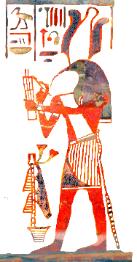
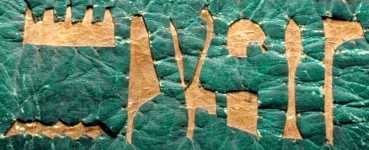
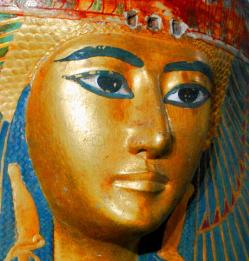
Upper left: mask, outer coffin of the God's Wife of Amun Hmt-nTr n jmnw
Maatkare mAatkAraw, Cairo CG61028. Upper right: Toth DHwty writing, inner
coffin of the Chantress of Amun Smayt n jmnw Shebty Sbty, Cairo JE29711.
Below text: the title Hm-nTr-tpy n jmnw (High Priest of Amun, or simply
HPA) from the unique leather funerary baldachin of Isetemkheb B
AstmAxbjt, Cairo JE26276, a seriously neglected beautiful element of
humankind's heritage which we hope to move, conserve, and display in
the near future.
My plan for this extremely difficult project was approved by the SCA
(Supreme Council of Antiquities of the Arab Republic of Egypt)
just before the Revolution. We can now only hope that our RIEC
permission will still be valid when a new, stable government rules Egypt.
(All words on this site in bright blue are links to related information. As the
site is now in reconstruction, some of the targeted pages may be empty)
Edward R. Loring,
Research Fellow,
CESRAS/RIEC Editor (admin@cesras.org)
Updated 26.11.2014
Maatkare mAatkAraw, Cairo CG61028. Upper right: Toth DHwty writing, inner
coffin of the Chantress of Amun Smayt n jmnw Shebty Sbty, Cairo JE29711.
Below text: the title Hm-nTr-tpy n jmnw (High Priest of Amun, or simply
HPA) from the unique leather funerary baldachin of Isetemkheb B
AstmAxbjt, Cairo JE26276, a seriously neglected beautiful element of
humankind's heritage which we hope to move, conserve, and display in
the near future.
My plan for this extremely difficult project was approved by the SCA
(Supreme Council of Antiquities of the Arab Republic of Egypt)
just before the Revolution. We can now only hope that our RIEC
permission will still be valid when a new, stable government rules Egypt.
(All words on this site in bright blue are links to related information. As the
site is now in reconstruction, some of the targeted pages may be empty)
Edward R. Loring,
Research Fellow,
CESRAS/RIEC Editor (admin@cesras.org)
Updated 26.11.2014
Click me for the site directory
Click me for the
Network Directory
Network Directory